
Blockchain for Teens: A Parent Guide to Safe DeFi Learning
A practical parent guide to blockchain for teens: what students should learn, how DeFi simulations build real skill, and how to keep crypto curiosity safe.
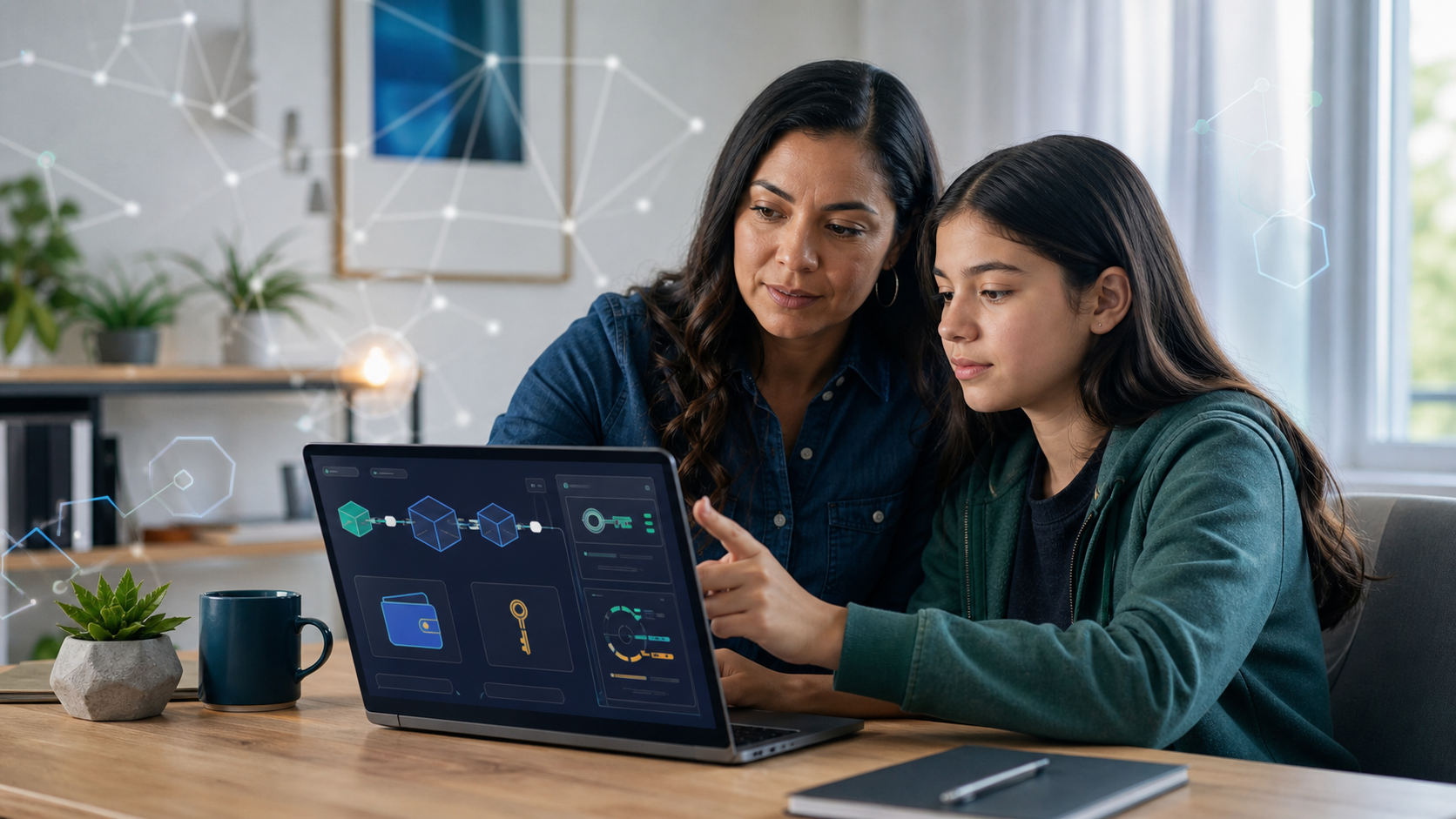
Blockchain for teens is worth learning when it is taught as computer science, financial systems, and security thinking, not as a shortcut to trading crypto. A strong teen blockchain path should use simulations, Python projects, clear safety rules, and parent-visible outcomes so students understand hashes, wallets, transactions, tokens, decentralized exchanges, lending, and risk without being pushed into real-money speculation.
For parents, the goal is simple: help a curious teen understand one of the major technical ideas behind modern finance and digital ownership while building durable skills they can transfer into software engineering, cybersecurity, data science, fintech, and AI-era product work.
Quick Answer: What Parents Should Know
Blockchain is a database design for recording transactions across a network, usually with cryptographic links between records. DeFi, short for decentralized finance, uses blockchain-style systems to model financial actions such as swaps, lending, borrowing, collateral, and tokens without the same central intermediaries used in traditional finance.
That does not mean a teen should be trading crypto. It means a teen can learn valuable technical ideas through controlled simulations:
- how a hash turns data into a fingerprint;
- why blocks link together;
- what a wallet key represents;
- how a transaction changes balances;
- how token supply and permissions work;
- why automated market makers use formulas;
- how lending protocols think about collateral and risk;
- why security, verification, and responsible assumptions matter.
Families comparing online STEM classes, coding classes for kids and teens, or a focused Blockchain (DeFi) course should look for that difference. The right version teaches systems. The wrong version sells hype.
Why Blockchain Is Suddenly a Parent Education Topic
Many parents first hear about blockchain through headlines about bitcoin prices, meme coins, scams, exchange failures, or online investment pitches. That makes the topic feel risky, and often it is. The Federal Trade Commission warns that cryptocurrency payments usually lack the protections families expect from credit cards or debit cards, and crypto transactions are typically difficult to reverse once sent. The FBI's 2024 Internet Crime Report also recorded 149,686 cryptocurrency-related complaints and more than $9.3 billion in reported losses.
Those facts are a reason to teach better judgment, not a reason to leave teens with only social media explanations. A teen who understands the technology is better prepared to spot bad claims.
The U.S. Securities and Exchange Commission describes crypto assets as assets generated, issued, or transferred through blockchain or similar distributed ledger technology. It also notes that different crypto assets can carry very different risks. That distinction matters for education: "blockchain" is not one thing. It is a family of technical patterns, economic incentives, software systems, interfaces, and security tradeoffs.
When a teen learns blockchain well, they are not memorizing coin names. They are learning how digital systems represent trust.
Blockchain Education Is Not Crypto Investing
The most important parent boundary is this: blockchain education should be separated from real-money investing.
A serious teen course should not encourage students to buy tokens, chase returns, follow influencers, connect unknown wallets, or treat market speculation as proof of intelligence. It should use fictional tokens, simulated wallets, sandbox data, and constrained projects. Students can learn the mechanics without taking financial risk.
This distinction protects the student and improves the learning. Real markets are noisy. A price going up does not prove a student understood the system. A simulation is better for beginners because the instructor can control the rules, show cause and effect, and ask the student to explain what happened.
For example, if a student builds a small token ledger in Python, they can inspect every balance change. If they build a simple automated market maker, they can change pool sizes and see how price impact changes. If they build a lending simulation, they can test what happens when collateral value falls. That is technical learning. It is also better financial literacy than a hype video.
What Teens Actually Learn From Blockchain
Blockchain can sound abstract until parents see the underlying skills. A strong course should connect the topic to concrete technical outcomes.
Hashing and Data Fingerprints
A hash function takes input data and produces a fixed-looking output. Students can use this to understand why changing one character changes the fingerprint. This is a powerful bridge into cybersecurity because it introduces integrity, tamper evidence, and verification.
For teens who may later explore Ethical Hacking, hashing is not just a blockchain idea. It appears in passwords, file checks, digital signatures, certificates, and secure software workflows.
Blocks, Chains, and Tamper Evidence
Students can model a block as a small record containing data, a timestamp or index, and the previous block's hash. When the previous hash is included, the records become linked. If an old record changes, the later links no longer match.
That is the first moment many teens understand the phrase "chain" in blockchain. It is not magic. It is a data structure with verification rules.
Wallets, Keys, and Identity
Wallets are often misunderstood. In many blockchain systems, the wallet is less like a leather wallet full of money and more like a tool for controlling keys. Students can learn the difference between public identifiers, private secrets, signatures, and permissions.
This is also where safety habits belong. Teens should understand that private keys, seed phrases, account recovery codes, and authentication tokens are not casual screenshots. They are control mechanisms.
Transactions and State
A transaction is a proposed change to the system. It might move a token, mint a simulated asset, deposit into a pool, or borrow against collateral. Students can learn to ask:
- What state exists before the transaction?
- Who is allowed to make the change?
- What rule validates the change?
- What state exists after the transaction?
- What could go wrong if the rule is incomplete?
That habit transfers directly into web development, backend systems, databases, cybersecurity, and AI tool design.
Tokens and Incentives
Tokens help students see how software can represent units, access, membership, points, credits, or simulated assets. The educational value is not "make a coin." It is learning how supply, permissions, transfers, and incentives interact.
A thoughtful course should also teach restraint. Just because software can create a token does not mean the token has real value, social value, legal clarity, or ethical purpose.
DeFi Simulations
DeFi is where blockchain education becomes especially useful for teens who like math, finance, systems, or game-like mechanics. A student can model:
- a swap pool with two simulated assets;
- price impact from pool size;
- a lending pool with deposits and borrows;
- a collateral ratio;
- a stablecoin model;
- a basic dashboard that shows balances and protocol state.
These projects can make algebra, ratios, risk, and programming feel practical. They also connect naturally to Python for Teens and finance-oriented technical paths such as Algorithmic Trading (Finance), as long as the environment is clear that students are modeling systems rather than receiving investment advice.
A Safe Blockchain Learning Path by Age
Not every student needs blockchain at the same age. The right starting point depends on maturity, typing comfort, math readiness, and judgment.
Ages 10-12: Concepts, Not DeFi
Younger students can learn the idea of a shared ledger through unplugged activities, simple lists, and beginner coding. They might create a class points ledger, a game inventory, or a simple "chain" of records where each entry depends on the previous one.
At this stage, the best first step is usually general coding. Python for Kids, game projects, creative coding, and basic debugging give students the foundation they need before finance-like simulations.
Ages 13-15: Python Models and Safety Rules
Middle-school and early high-school students can begin using Python to model hashes, blocks, simple wallets, balances, and token transfers. This is also the right time to teach scam awareness, private information rules, and the difference between a learning simulation and an investment product.
The student should be able to explain their code in plain language. If they cannot explain what changes after a transaction, the project is too advanced or too rushed.
Ages 15-18: DeFi, Security, Data, and Portfolio Work
Older teens can handle more sophisticated projects: automated market makers, lending simulations, stablecoin models, live data inputs, risk dashboards, and technical writeups. They can also compare blockchain systems with ordinary databases, payment processors, and traditional finance.
At this level, portfolio evidence matters. A teen should not only show the program running. They should document assumptions, limitations, edge cases, tests, and safety boundaries. That connects well with a broader coding portfolio for teens.
Parent Decision Criteria: Is a Blockchain Course Worth It?
Use these questions before choosing a blockchain or DeFi course for a teen.
Does it use simulations before real systems?
For beginners, simulations are not a weakness. They are the safer and clearer teaching environment. Students should first learn with fictional balances, classroom tokens, local Python programs, and sandboxed data.
Does it teach security and skepticism?
A serious course should discuss scams, irreversible payments, wallet safety, phishing, impersonation, and unrealistic profit claims. It should never frame skepticism as negativity. In technical fields, skepticism is part of competence.
Does it build programming skill?
The course should produce real code, not just vocabulary. Look for Python programs, transaction models, simple dashboards, tests, debugging practice, and student explanations.
Does it avoid investment promises?
No teen course should promise income, returns, trading success, or market advantage. If the marketing sounds like "get ahead in crypto" instead of "understand systems," keep looking.
Does it connect to broader technical paths?
Blockchain can lead toward fintech, cybersecurity, backend engineering, distributed systems, economics, data analysis, AI product design, and responsible entrepreneurship. It should not isolate the student inside a narrow hype cycle.
Healthy Projects for Teens
Here are examples of blockchain projects that build real skill without real-money risk.
1. Hash Explorer
The student writes a Python program that takes input text and prints a hash. They change one character and compare the result. Then they write a short explanation of why tamper evidence matters.
2. Mini Blockchain Ledger
The student creates a list of blocks where each block stores data and the previous block's hash. They add a validation function that checks whether the chain still matches.
3. Simulated Wallet and Transfers
The student creates fictional accounts and balances. They write a transaction function that refuses negative transfers, unknown accounts, or transfers larger than the available balance.
4. Token Supply Model
The student models minting, burning, and transferring tokens. They explain who is allowed to change supply and what happens if permissions are too loose.
5. Automated Market Maker Simulation
The student builds a small swap model with two pools and a formula. They test small and large swaps and explain price impact in ordinary language.
6. Lending and Collateral Dashboard
The student models deposits, borrows, collateral ratios, and liquidation thresholds using fictional prices. The goal is to understand risk, not to imitate live trading.
7. DeFi Safety Checklist
The student writes a checklist for evaluating claims: Who controls the code? What can be changed? What data is public? What happens if a key is lost? What claims sound too good to be true?
These projects are small enough to teach clearly and substantial enough to become portfolio artifacts.
How AI Changes Blockchain Learning
AI tools can help teens learn blockchain, but they also make shortcuts easier. A student can ask AI to explain a hash, suggest test cases, or compare two versions of a transaction function. That can be helpful. But AI can also invent false details, oversimplify regulation, produce insecure code, or confuse a simulated project with real financial advice.
Parents should look for courses that use AI as a mentor, not as an answer machine. The student should still write code, run tests, inspect outputs, and explain tradeoffs. This is the same standard families should use for AI coding assistants for kids: AI support is useful only when it makes the learner stronger.
Red Flags Parents Should Watch For
Be cautious if a program, video, club, or online community:
- asks students to connect a real wallet before they understand keys;
- encourages buying a token as part of learning;
- promises profits, passive income, or secret strategies;
- treats skepticism as being "late" or "not getting it";
- focuses on price charts more than code and systems;
- ignores scams, phishing, and irreversible payments;
- uses celebrity, influencer, or group-chat pressure;
- cannot explain whether students are using real funds or simulations.
The FTC warns that scammers often promise guaranteed returns, demand crypto payments, or use social media and dating-style trust building to push fake investments. Teens need direct language about this. If someone promises easy money, pressures secrecy, or tells a student to move fast before asking a parent, the safest answer is no.
What Student Outcomes Should Look Like
By the end of a strong blockchain learning path, a teen should be able to:
- define blockchain in plain language;
- explain why hashes make tampering easier to detect;
- describe the difference between a wallet address and a private key;
- model a transaction and check whether it is valid;
- build a small ledger or token simulation in Python;
- explain automated market makers without pretending they are risk-free;
- identify common crypto scam patterns;
- write a project summary with assumptions, limitations, and tests.
That is meaningful technical growth. It is also a healthier outcome than memorizing buzzwords.
How Generation STEM Approaches Blockchain and DeFi
Generation STEM's Blockchain (DeFi) course is designed as a Python-powered DeFi Lab notebook. Students build runnable programs around hashes, blocks, proof of work, wallets, tokens, automated market makers, lending, stablecoins, and a mini protocol.
The point is not to turn teens into traders. The point is to help them understand how technical systems model trust, value, permissions, incentives, and risk. For students who need stronger foundations first, Python for Teens, Website Development, or broader online STEM classes may be the better starting path.
FAQ
Is blockchain good for teens to learn?
Blockchain can be good for teens when it is taught through coding, simulations, security, and systems thinking. It is not a good fit when it is framed as trading, speculation, or a promise of easy money.
What age should teens start learning blockchain?
Many students are ready for beginner blockchain concepts around ages 13-15 if they have some coding foundation and can follow safety rules. More advanced DeFi simulations usually fit better for older teens who are comfortable with Python, ratios, debugging, and careful explanations.
Should my teen buy crypto to learn blockchain?
No. A teen does not need to buy cryptocurrency to learn blockchain. Simulated wallets, fictional tokens, Python ledgers, and sandbox projects are safer and better for understanding the mechanics.
Is DeFi safe for students?
Real DeFi systems can involve financial, technical, legal, and security risks. Student learning should use simulations and fictional balances. The educational goal is to understand how DeFi models work, not to participate in real protocols with real money.
Is blockchain mostly finance, or does it teach computer science?
Blockchain can teach computer science when the course focuses on hashes, data structures, transactions, validation, keys, permissions, testing, and security. Finance is one application, but the deeper lesson is how distributed systems represent and verify state.
What should parents ask after a blockchain lesson?
Ask your teen to explain what the program modeled, what rules checked a transaction, what could go wrong, and what safety boundary kept the project fictional. A strong learner should be able to describe the system without relying on hype words.
Suggested Next Reading
- Algorithmic Trading for Teens: A Parent Guide to Finance, Coding, and Risk
- Python Automation Projects for Teens: Useful Scripts That Build Real Skill
- Cybersecurity Projects for Teens: Safe Ways to Build Real Security Skills
- Coding Portfolio for Teens: Projects That Prove Real Tech Skills
- AI Coding Assistants for Kids: How to Use AI Without Skipping the Learning
Sources
- FTC: What To Know About Cryptocurrency and Scams
- SEC Investor.gov: Crypto Assets
- FBI IC3 2024 Internet Crime Report
Help Your Teen Learn Blockchain Safely
If your teen is curious about blockchain, give that curiosity structure before the internet gives it hype. Explore Generation STEM's Blockchain (DeFi) course, compare broader online STEM classes, or review family pricing when you are ready for a guided path that keeps technical learning separate from financial speculation.