
Algorithmic Trading for Teens: Learn Python, Markets, and Risk Safely
How teens can use simulated trading projects to learn Python, data analysis, testing, and financial risk without chasing quick profits.
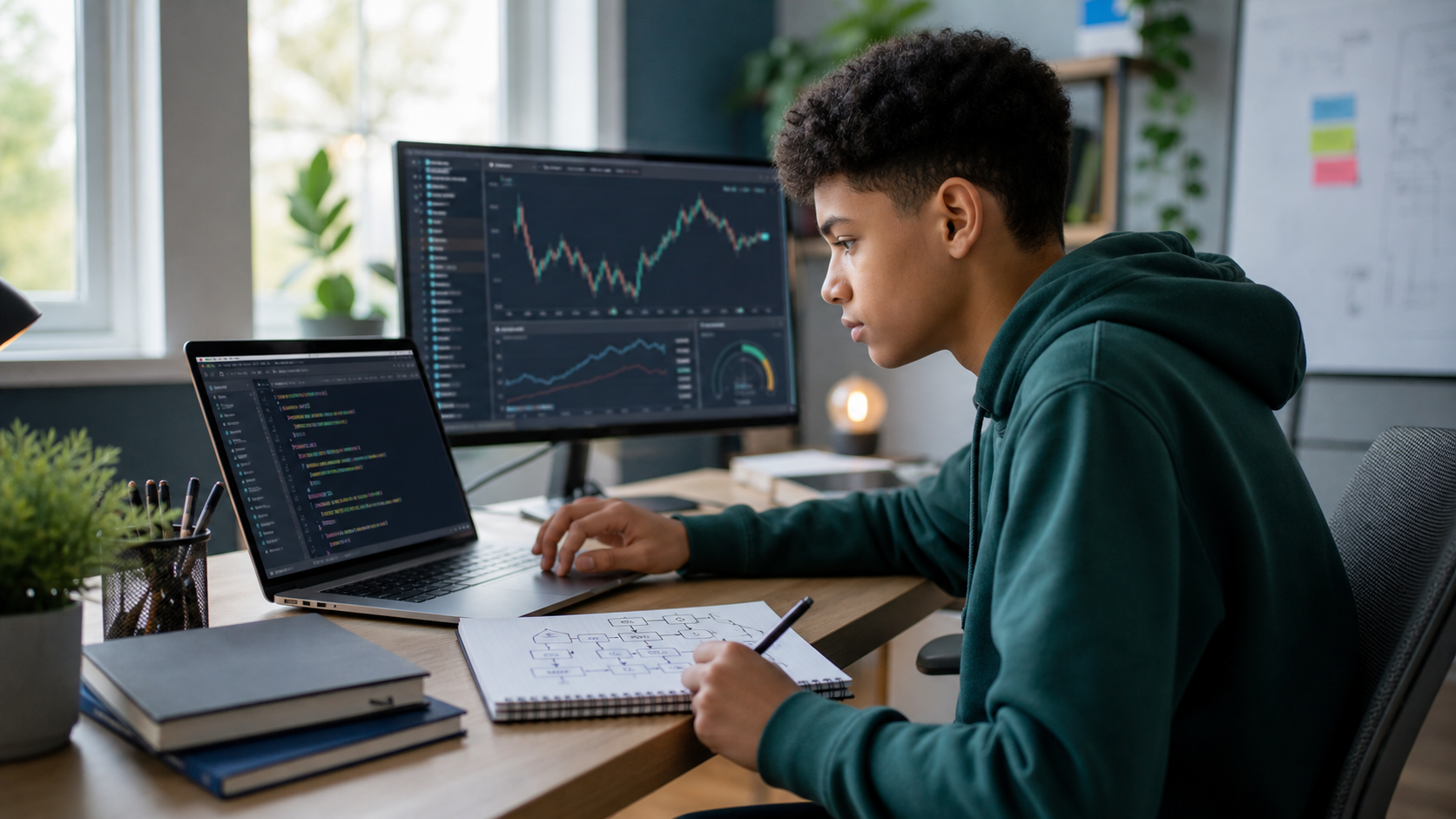
A teenager sees a video claiming that an AI trading bot can predict the market, make money while its owner sleeps, and turn a few lines of code into financial freedom. The pitch sounds technical. It may even include a polished chart. But it skips the questions that matter: Was the strategy tested on data it had never seen? Were fees included? How large were the losses? Did the system actually trade, or is the result only a carefully selected simulation?
That gap between a convincing chart and reliable evidence is exactly why algorithmic trading can be a valuable learning topic—when it is taught as a coding and risk-analysis project, not as a shortcut to profit.
For teens who already know basic programming, market data creates a demanding laboratory. Students must define rules precisely, clean imperfect data, test assumptions, measure failure, and explain why a result may not repeat. Those are useful skills in software engineering, data science, finance, and AI.
Quick Answer: What Is Algorithmic Trading for Teens?
Algorithmic trading for teens is the study of how computer programs turn explicit market rules into testable decisions using historical or simulated data. A safe student project does not connect to real money. It uses paper trading or an offline backtest to investigate questions such as:
- How can Python represent a price series?
- What does a moving average measure?
- How should a program calculate profit, loss, and drawdown?
- Can a rule work on one time period but fail on another?
- What happens after realistic costs and delays are included?
- How can a student document uncertainty instead of hiding it?
The educational goal is not “beat the market.” It is to build a system, test it honestly, find its weaknesses, and communicate the evidence.
Why This Topic Is Timely in 2026
Automated investing claims are increasingly visible in social feeds, group chats, and app advertising. In July 2025, FINRA warned that it had identified an increase in unregistered services promoting automated trading to retail investors. Some advertised beginner-friendly or “risk-free” systems, consistent monthly returns, or special AI advantages. FINRA highlighted unsupported profit claims, unsuitable trades, privacy risks, and “AI washing” as specific concerns.
The broader information environment is also difficult for young people to evaluate. The FINRA Investor Education Foundation's 2025 national survey found that 61% of investors under 35 used recommendations from social media influencers when making investment decisions. In December 2025, the SEC alleged that fake investment clubs had used purported AI-generated tips and fake trading platforms in a scheme that took more than $14 million from retail investors.
Those facts do not mean teens should avoid learning about markets. They mean the learning standard should be higher than a viral screenshot. Students need enough coding, statistics, and financial literacy to ask how a claim was produced and what it leaves out.
Algorithmic Trading Is a Software Project Before It Is a Finance Project
A trading strategy starts as an idea stated in ordinary language: “Buy when the short-term trend rises above the long-term trend.” Code cannot act on that sentence until the student resolves every ambiguity.
- Which prices are used: opening, closing, or adjusted closing prices?
- How many days count as short term and long term?
- Does the decision happen before or after today's price is known?
- When does a simulated order take effect?
- What happens when data is missing?
- How much of the simulated portfolio can be used?
- What rule closes the position?
This process turns vague intuition into an executable specification. That is core engineering work.
A simple classroom rule might look like this:
short_average = mean(prices[-5:])
long_average = mean(prices[-20:])

if short_average > long_average:
    signal = "ENTER_SIMULATION"
else:
    signal = "WAIT"
This is not a complete strategy and should not control a brokerage account. It is a compact way to practice lists, functions, conditionals, slicing, and clear variable names. The hard work begins after the code runs: checking whether it uses future information, deciding how to evaluate it, and explaining when it fails.
Students who need stronger foundations first can build those skills through a structured Python for Teens course before working with time-series data.
Seven Skills Teens Can Learn From a Simulated Trading Project
1. Turning a question into a precise rule
“Buy low and sell high” is not an algorithm. A student has to define low, high, entry, exit, time range, and position size. Precision exposes assumptions that casual discussion hides.
2. Cleaning and validating data
Real datasets may contain missing dates, duplicate rows, inconsistent formats, or prices adjusted for corporate events. A strong student checks column types, date order, missing values, and the source before trusting a graph.
3. Working with functions and state
Backtests track cash, positions, entry prices, and portfolio value as time advances. This creates a meaningful reason to use functions, loops, dictionaries, and state instead of practicing syntax in isolation.
4. Understanding risk and return together
A large final number tells only part of the story. The U.S. government's Investor.gov explains that every investment involves risk and that diversification and asset allocation are important ways investors manage it. In a simulation, students can compare total return with volatility, maximum drawdown, and the size of the worst loss.
5. Separating training data from new data
If a student changes a rule repeatedly until it fits one historical period, the strategy may simply memorize noise. Testing on a later, untouched period introduces the same train-test distinction used in machine learning.
6. Debugging invisible mistakes
Some bugs crash a program. More dangerous bugs produce a beautiful but impossible result. A backtest may accidentally use tomorrow's price to make today's decision, ignore transaction costs, or let the system trade at a price that was not yet available. Teens learn to distrust output until they can audit the process.
7. Communicating uncertainty
A credible project report states limitations. It separates “worked in this simulation” from “will work in the future.” That habit matters anywhere data is used to persuade.
Backtesting: The Core Learning Activity
A backtest runs a set of rules over historical data to estimate how those rules would have behaved. It is useful for learning, but it is not a time machine and not proof of future performance.
A responsible beginner backtest should include:
- a clearly stated hypothesis;
- a documented data source and date range;
- rules written before the final test;
- separate development and test periods;
- simulated fees and execution delay;
- a simple comparison benchmark;
- return and risk measurements; and
- a written account of failures and limitations.
FINRA's guidance for professional algorithmic trading emphasizes software testing and system validation before production. A student project is much smaller, but the principle transfers: code should not be trusted merely because it executes.
Metrics that make the project more honest
| Metric | What it answers | What it does not prove |
|---|---|---|
| Total return | How much did the simulated value change? | That the result will repeat |
| Maximum drawdown | What was the largest decline from a prior peak? | That the next decline cannot be larger |
| Win rate | What share of simulated trades gained value? | That the strategy was profitable overall |
| Average gain vs. average loss | Were wins large enough relative to losses? | That costs and timing were realistic |
| Number of trades | Is the result based on many events or only a few? | That the sample represents the future |
| Benchmark return | Did the rules outperform a simple comparison? | That added complexity was worth its risk |
A strategy can win often and still lose money if its occasional losses are large. It can show a positive return while performing worse than a simple benchmark. These are valuable discoveries, not failed assignments.
A Safe Six-Stage Learning Path
Stage 1: Build the math without market data
Start with a savings-growth calculator. Let the student change contribution, time, and assumed rate, then graph the results. Investor.gov provides youth activities for compound interest and the Rule of 72. This establishes percentages, repeated growth, and the difference between an assumption and a guarantee.
Stage 2: Analyze a static dataset
Load a prepared CSV file and calculate daily changes, averages, highest and lowest values, and rolling statistics. The goal is data literacy, not a trading decision.
Stage 3: Write one transparent signal
Create a rule with only a few parameters. The student should be able to explain each line and predict what changing a parameter will do before running the code.
Stage 4: Build a backtest
Advance through the dataset one row at a time. Record every simulated decision, update portfolio state, and produce an audit log. No real brokerage credentials or money should be involved.
Stage 5: Try to break the result
Test different dates, a different asset, added costs, delayed execution, and missing data. Look for cases where the strategy performs poorly. This “red team” stage is where much of the learning happens.
Stage 6: Present an evidence report
The final deliverable should include the question, method, code architecture, results, benchmark, limitations, and next experiment. A project that concludes “this rule was fragile” can demonstrate more understanding than one that advertises a large simulated return.
Generation STEM's Algorithmic Trading course for teens follows this project-first direction: Python, compounding, market data, risk, signals, backtesting, and evaluation are treated as connected technical concepts.
Paper Trading vs. Backtesting vs. Live Trading
These terms are related but not interchangeable.
Backtesting applies rules to historical data. It is fast and reproducible, but vulnerable to data leakage, overfitting, and unrealistic assumptions.
Paper trading simulates decisions as current market conditions unfold. It removes direct financial loss, but simulated execution can still differ from real markets and may encourage emotionally charged scorekeeping.
Live trading sends real orders involving real money. It adds financial, legal, operational, privacy, and emotional consequences. It is not necessary for a teen to learn the coding concepts in this article.
For an educational project, offline backtesting is usually the clearest starting point. It lets a parent or teacher inspect the data, code, and results without creating a financial account.
Where AI Helps—and Where It Can Hide Weak Learning
AI can explain an error message, suggest a plotting function, generate test cases, or help a student reorganize repetitive code. Those uses can accelerate feedback.
AI should not become the unexplained author of the strategy. A student who pastes in generated code, sees a rising chart, and calls it a successful bot has not demonstrated understanding. The minimum standard should be:
- explain every rule in plain language;
- identify which data each decision can access;
- write or verify tests for calculations;
- change one assumption and predict the effect;
- disclose where AI assisted; and
- reject any claim of guaranteed or risk-free returns.
AI can also make bad financial claims look authoritative. FINRA and other regulators have warned about investment fraud that invokes AI, while FINRA's 2025 auto-trading notice specifically describes exaggerated technology and profitability claims. Technical vocabulary is not evidence.
Red Flags for Parents
Avoid a course, app, creator, or project brief that:
- promises profit, passive income, or a reliable winning rate;
- asks a teen to connect brokerage credentials;
- encourages real-money trading as proof of learning;
- treats a backtest chart as a forecast;
- hides losing periods or does not use a benchmark;
- promotes leverage, options, or highly volatile assets to beginners;
- claims an AI model removes market risk;
- cannot explain where its data came from;
- rewards the largest simulated balance instead of the strongest analysis; or
- uses urgency, secrecy, or social proof in place of evidence.
FINRA's investor guidance is direct: all investments carry risk. Its 2025 warning also advises people to be careful about sharing personal information or account credentials with auto-trading providers. A teen coding project never needs that access.
What Parents Should Look For Instead
A serious learning experience should make the following visible:
- Simulation only: no real money, brokerage connection, or financial recommendation.
- Readable code: the student can trace inputs, logic, and outputs.
- Testing discipline: calculations have test cases and strategies face unseen data.
- Risk measurements: losses and drawdowns appear beside returns.
- Simple benchmarks: complexity must earn its place.
- Ethical data use: sources, licenses, privacy, and limitations are documented.
- Student ownership: the learner can explain decisions without an AI assistant speaking for them.
- A technical artifact: code, charts, an audit log, and a written report remain after the course.
The strongest question is not “How much did the bot make?” It is “What did you test, what could be wrong, and what evidence changed your mind?”
FAQ
Is algorithmic trading appropriate for teenagers?
It can be appropriate as a supervised Python, data, and risk-analysis project. Teens do not need to trade real money. Offline backtesting and simulation teach the core technical concepts with much safer boundaries.
What age should a student start learning algorithmic trading?
Many students are ready around ages 13 to 17 if they understand variables, conditionals, loops, functions, percentages, and basic graphs. Readiness matters more than age; beginners should build Python foundations first.
Does a teen need advanced math?
No. A first project can use percentages, averages, comparisons, and charts. Statistics becomes more important as projects advance, but calculus is not required for a responsible beginner backtest.
Can a student build a trading bot with Python?
A student can build a simulated decision system and backtester with Python. Connecting software to a live brokerage account introduces risks that are unnecessary for learning and should not be the goal of a beginner course.
Is backtesting proof that a strategy works?
No. Backtests can be distorted by overfitting, future-data leakage, selected dates, missing costs, and unrealistic execution. They are experiments on historical data, not guarantees about future performance.
Should teens use AI to write a trading strategy?
AI can assist with explanations, debugging, and tests, but the student should understand every rule and validate every calculation. AI-generated code and polished charts do not establish that a strategy is safe, correct, or profitable.
What is the best outcome from this kind of project?
The best outcome is a well-tested technical report: clear code, an auditable simulation, honest risk metrics, a benchmark, documented limitations, and a student who can explain what failed as clearly as what worked.
Suggested Related Articles
- Data Science for Kids: Why Data Literacy Matters in the AI Era
- Python Projects for Kids: Beginner Ideas That Build Real Coding Skill
- AI Coding Assistants for Kids: How to Use AI Without Skipping the Learning
- Coding Portfolio for Teens: Projects That Prove Real Tech Skills
- Future-Proof Skills for Kids in the AI Era
Start With the System, Not the Promise
Markets make a compelling project context because the data changes, the results are uncertain, and weak assumptions can produce convincing output. That is also why the topic needs careful boundaries.
A teen does not need a live account or a secret AI signal to learn from algorithmic trading. They need a clear question, readable Python, trustworthy data, a simulation, tests, risk measurements, and permission to discover that an idea does not work.
That process builds something more durable than a lucky chart: the ability to turn claims into code, code into evidence, and evidence into better judgment.
Educational note: This article describes coding and simulation activities, not investment advice. All investing involves risk. Families should use qualified financial and legal guidance for real financial decisions.
Sources
- FINRA: Know the Risks of Auto-Trading Services Offered by Unregistered Entities
- FINRA: Algorithmic Trading—Supervision and Control Practices
- FINRA Foundation: 2025 National Financial Capability Study Investor Survey
- SEC: Charges Involving Purported AI Investment Tips and Fake Trading Platforms
- Investor.gov: Introduction to Investing, Risk, and Diversification
- Investor.gov: Compound Interest Classroom Resource
- Python.org: Python for Beginners
- U.S. Bureau of Labor Statistics: Data Scientists Occupational Outlook