
Quantum Computing for Teens: A Practical Parent Guide for 2026
A realistic guide to quantum computing for teens, from qubits and circuits to Python projects, cloud hardware, cybersecurity, and future study paths.
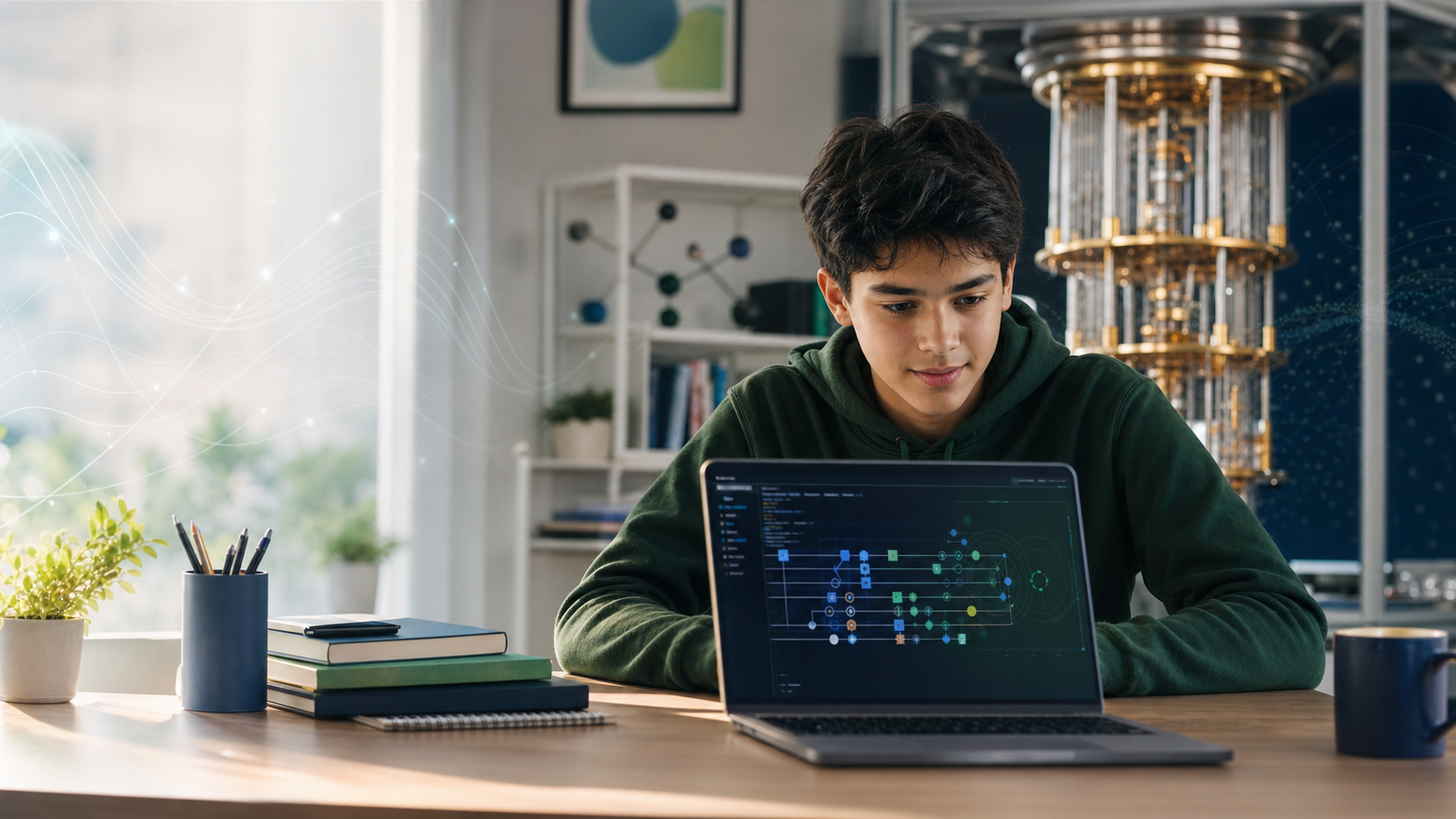
Quantum computing can sound like a topic reserved for research physicists. The vocabulary is unusual, the hardware looks unfamiliar, and popular explanations often jump from “qubits” to claims that quantum machines will solve every difficult problem. That makes it hard for parents to tell whether a teen is exploring a serious technical field or only absorbing science-fiction language.
The useful middle ground is more practical. Teenagers can learn the central ideas of quantum information, build small circuits in a simulator, run carefully scoped experiments on cloud-accessible hardware, and connect those experiments to Python, probability, cybersecurity, chemistry, and computer science. They do not need to master university physics first. They do need a course or project that treats uncertainty, hardware limits, and evidence honestly.
Quick Answer: Can Teenagers Learn Quantum Computing?
Yes. Motivated teens can begin quantum computing by learning how qubits are prepared, changed by gates, measured, and combined into circuits. A beginner can work visually before moving into Python. High school students who understand basic algebra, graphs, and probability can go further into circuit code and algorithms; advanced physics and calculus can come later.
A strong first experience should help a student:
- compare classical bits with qubits without claiming they are the same;
- predict a simple circuit before running it;
- collect repeated measurements and interpret a distribution;
- explain superposition, entanglement, interference, and noise in careful language;
- use a simulator before using scarce real hardware;
- document what a result does and does not show; and
- connect quantum ideas to established coding and math skills.
The goal is not to make a teenager a “quantum engineer” in a few weeks. It is to give the student enough conceptual and technical experience to decide whether the field deserves deeper study.
Why Quantum Education Is Timely in 2026
Quantum education is moving beyond occasional university outreach. In June 2026, the U.S. National Science Foundation highlighted classroom programs designed to inspire the next generation of the quantum workforce. NSF also supports the National Q-12 Education Partnership, which collects learning tools and promotes quantum experiences from middle school through high school.
Access to hardware is changing too. In May 2026, IBM announced Classroom Accounts that let educators manage groups of 5 to 100 students and provide limited cloud access to real quantum computers without requiring a credit card. That does not make quantum hardware simple or mature. It does mean that a student experiment no longer has to remain a drawing in a textbook.
The field is also relevant to security. The National Institute of Standards and Technology finalized its first three post-quantum cryptography standards in 2024 and now encourages organizations to begin transitioning. This is an important distinction for students: post-quantum cryptography runs on classical computers and is designed to resist future quantum attacks; it is not the same as quantum cryptography.
These are good reasons to learn the field, but not reasons to exaggerate it. Current quantum devices are noisy, specialized systems. They do not replace laptops, and they do not automatically make every calculation faster.
What Makes a Quantum Computer Different?
A classical bit stores one of two definite values: 0 or 1. A qubit is described by a quantum state that can assign amplitudes to both possible measurement outcomes. When the qubit is measured, the result is classical—0 or 1—but repeated preparations and measurements reveal a probability distribution.
That wording matters. Saying a qubit is “both 0 and 1 at once” can be a useful first metaphor, but it becomes misleading if a student imagines that measurement simply reads two ordinary values simultaneously.
Four concepts form a useful beginner foundation.
Superposition
A quantum gate can prepare a qubit so that repeated measurements sometimes return 0 and sometimes return 1. The state before measurement carries amplitude and phase information, not merely an unknown classical answer.
Measurement
Measurement produces a classical outcome and changes what can be known about the state. Because one result is not enough to describe a probability distribution, experiments are commonly repeated for many “shots.”
Entanglement
Multiple qubits can share a state whose measurement patterns cannot be explained by assigning an independent state to each qubit. Entanglement creates correlations, but it does not allow faster-than-light messaging.
Interference
Quantum amplitudes can reinforce or cancel. Useful quantum algorithms are designed so that unwanted outcomes become less likely and desired outcomes become more likely. Superposition alone is not a free parallel computer; interference is part of how an algorithm turns quantum behavior into a result.
Quantum Computing Is Still Computing
The most valuable beginner work looks familiar to a software engineer. A student defines an initial state, applies operations in order, runs the circuit, gathers output, and checks whether the result matches a prediction.
For example, this small Qiskit-style Python circuit creates an entangled pair:
from qiskit import QuantumCircuit

circuit = QuantumCircuit(2)
circuit.h(0)
circuit.cx(0, 1)
circuit.measure_all()
The Hadamard gate prepares the first qubit in a superposition. The controlled-X gate links the second qubit to the first. In an ideal simulation, repeated measurements should be concentrated around 00 and 11, rather than spread evenly across all four two-bit results.
The code is short; the learning is in the questions around it:
- What result do you predict before running the circuit?
- Why are many measurements needed?
- What changes if the controlled-X gate is removed?
- Why might real hardware also produce a few
01or10results? - Does correlated output by itself prove every claim made about entanglement?
Students who cannot yet read the code should build a conventional programming foundation first. Structured coding classes for kids and teens can make variables, functions, debugging, and evidence-based testing feel normal before quantum libraries add a new abstraction layer.
What Math Does a Teen Need?
The answer depends on the depth of the project.
| Learning goal | Useful preparation | Not required yet |
|---|---|---|
| Understand the big ideas | Fractions, graphs, basic probability | Calculus |
| Build visual circuits | Logical sequences and coordinate-style diagrams | Formal quantum mechanics |
| Code beginner circuits | Python basics, functions, lists | Advanced software architecture |
| Understand state vectors | Algebra, complex numbers, vectors | A physics degree |
| Study algorithms deeply | Linear algebra, probability, proofs | Experimental hardware expertise |
For a first course, probability is more important than calculus. A teenager should be comfortable asking what repeated trials show, why a sample differs from an ideal prediction, and whether a conclusion is supported by enough data.
Math should become a tool for explaining an observed pattern, not an entrance exam that blocks curiosity. At the same time, a course that promises deep quantum algorithm mastery without eventually introducing vectors, matrices, complex amplitudes, and linear algebra is hiding essential structure.
Six Beginner Quantum Projects for Teens
1. Build a bit-versus-qubit experiment
Create a classical random-bit program, then compare it with a simulated qubit circuit using a Hadamard gate. Record what looks similar in the outputs and explain why the underlying models are different. This prevents “quantum equals randomness” from becoming an unexamined belief.
2. Test measurement distributions
Run the same circuit for 10, 100, and 1,000 shots. Graph the outcomes and calculate the difference from the ideal probability. The student learns sampling variation and sees why a single hardware run is weak evidence.
3. Create and break an entangled pair
Build the two-qubit circuit above, predict its output, and then remove one gate at a time. A strong report explains how each change affects the distribution instead of treating the finished circuit as a magic trick.
4. Compare a simulator with real hardware
Run one small circuit in an ideal simulator and on a cloud quantum processor. Compare the counts, then research noise, calibration, decoherence, and readout error. The mismatch is not an inconvenience; it is the project.
5. Map the post-quantum security transition
Research which common public-key systems could be threatened by a sufficiently capable quantum computer and which NIST standards are intended to replace vulnerable methods. Keep the project conceptual and defensive. The student should clearly separate quantum computing, quantum cryptography, and post-quantum cryptography.
6. Explain one proposed application honestly
Choose chemistry simulation, materials research, optimization, sensing, or secure communication. Create a one-page evidence brief with three columns: what researchers hope to do, what has been demonstrated, and what remains uncertain. This builds technical reading and protects against hype.
These projects fit well in flexible online STEM classes because students can combine code, simulations, visual explanations, and written reflection without needing a physical quantum laboratory at home.
A Six-Week Learning Path
Week 1: Classical information and probability
Review bits, logical operations, binary strings, random trials, percentages, and distributions. Build a small Python experiment and explain its output.
Week 2: Qubits, gates, and measurement
Use a visual circuit tool or simulator. Work with X and Hadamard gates, predict outcomes, and compare predictions with repeated measurements.
Week 3: Multi-qubit circuits
Introduce controlled gates and entanglement. Keep circuits small enough to trace by hand. Require a written prediction before every run.
Week 4: Code the circuits
Rebuild prior visual experiments in Python. Separate circuit construction, execution, and result analysis into understandable functions or notebook sections.
Week 5: Noise and hardware
Compare ideal and noisy simulations, then use real cloud hardware if age, account, and classroom policies permit. Treat queue time, limited access, and error as part of the engineering context.
Week 6: Capstone evidence brief
Choose an application, produce a small reproducible experiment, cite reliable sources, and present limitations. The final question should be “What did the evidence support?” rather than “Did quantum win?”
How AI Can Help Without Replacing the Learning
AI can translate an error message, quiz a student on gate behavior, propose test cases, or compare a student's explanation with a source. It can also confidently produce invalid circuits, confuse quantum and post-quantum cryptography, or describe theoretical speedups as current commercial facts.
Use a simple ownership standard:
- the teen predicts before asking AI;
- the teen can explain every gate and code line;
- simulator or hardware output is checked independently;
- factual claims link to a primary source;
- AI assistance is disclosed in the project notes; and
- the student records one AI answer that was incomplete or wrong.
Quantum computing is a particularly good environment for learning that technical-sounding output is not the same as verified output.
Is Quantum Computing a Good Career Path?
It can be a valuable field to explore, but a teenager should build broad foundations rather than specialize too narrowly. Quantum work spans physics, computer science, electrical engineering, mathematics, materials science, cybersecurity, product design, technical writing, and policy.
The U.S. Bureau of Labor Statistics does not publish a separate “quantum developer” category. It projects 20% employment growth for computer and information research scientists from 2024 to 2034, but many research roles require graduate study. That is useful context, not a guarantee about one emerging specialty.
For a teen, the durable path is:
- learn conventional programming well;
- strengthen algebra, probability, and eventually linear algebra;
- practice explaining experiments and uncertainty;
- explore physics and cybersecurity alongside computer science; and
- build a small portfolio that shows reasoning, not just certificates.
The same foundations remain useful if the student later chooses AI, robotics, security, data science, or ordinary software engineering. Related guides on future-proof technical skills and coding portfolios for teens can help parents keep that broader path in view.
What Parents Should Look For in a Quantum Course
A credible beginner program should include:
- accurate scope: it states that current quantum computers are specialized and noisy;
- active work: students build circuits, make predictions, and analyze results;
- classical foundations: coding, probability, and debugging are treated as essential;
- simulator-first access: real hardware is a later comparison, not a marketing gimmick;
- age-aware accounts: privacy, platform terms, and educator controls are clear;
- technical honesty: the course distinguishes demonstrated results from proposed applications;
- student explanation: learners defend their conclusions in their own words; and
- a finished artifact: a notebook, experiment log, visualization, or evidence brief remains.
Be cautious when a program promises guaranteed career advantage, claims quantum computers already solve all optimization or encryption problems, uses “quantum” as a label for ordinary AI, or skips the classical concepts students need to evaluate the work.
FAQ
What age can a child start learning quantum computing?
Students can encounter visual quantum concepts in middle school. Coding-focused study is often a better fit around ages 13 to 18, when a learner has basic algebra, probability, and programming experience. Readiness and interest matter more than a fixed age.
Does a teen need to know Python first?
Not for a first visual circuit activity. Python becomes useful when the student wants to build repeatable experiments, analyze measurement counts, and use frameworks such as Qiskit. Basic variables, functions, lists, and debugging are enough to begin.
Is quantum computing harder than normal coding?
It introduces unfamiliar math and physical rules, but beginner circuits can be small. The challenge is less about writing many lines of code and more about interpreting states, probabilities, measurements, and hardware error carefully.
Can students use a real quantum computer?
Yes, some providers offer cloud access to real devices, and IBM introduced educator-managed Classroom Accounts in 2026. Beginners should use simulators first and follow the provider's age, privacy, and account requirements.
Will quantum computers replace classical computers?
No. Quantum processors are designed for particular kinds of problems and depend on classical computers for control, compilation, and analysis. Classical systems will remain essential.
Does quantum computing break all encryption?
No. A sufficiently capable future quantum computer could threaten important public-key systems, but current devices cannot simply break all encryption. NIST has already standardized post-quantum algorithms designed to protect information using classical computers.
Is quantum computing only for students who want to study physics?
No. The field also needs computer scientists, engineers, mathematicians, security specialists, educators, communicators, and policy experts. Physics is important, but it is one of several entry points.
Suggested Related Articles
- Future-Proof Skills for Kids: What Matters Most in the AI Era
- Computational Thinking for Kids: The Problem-Solving Skill Behind Coding and AI
- Coding Portfolio for Teens: Projects That Prove Real Tech Skills
- Cybersecurity Career Path for Teens: What to Learn Before College
- Math for Coding Kids: What Parents Should Know
Sources
- U.S. National Science Foundation: Bringing quantum concepts into classrooms
- U.S. National Science Foundation: Quantum information science and workforce development
- National Q-12 Education Partnership: About the K-12 quantum initiative
- IBM Quantum: Classroom Accounts expand educator and student access
- IBM Quantum: A decade of quantum computing on the cloud
- NIST: What is post-quantum cryptography?
- U.S. Bureau of Labor Statistics: Computer and information research scientists
Turn Curiosity Into a Real Technical Foundation
Quantum computing is worth exploring because it asks students to combine code, math, physical models, and disciplined uncertainty. It should expand a teen's technical foundation, not distract from it.
Generation STEM helps young builders develop the conventional coding, debugging, project, and explanation skills that make advanced fields approachable. Explore our coding classes for kids and teens to start building that foundation through real work rather than passive technology hype.