Machine Learning for Kids: A Parent Guide to AI That Learns From Data
Machine learning for kids should not start with black-box AI tools. It should start with patterns, data, predictions, testing, and clear explanations students can actually understand.
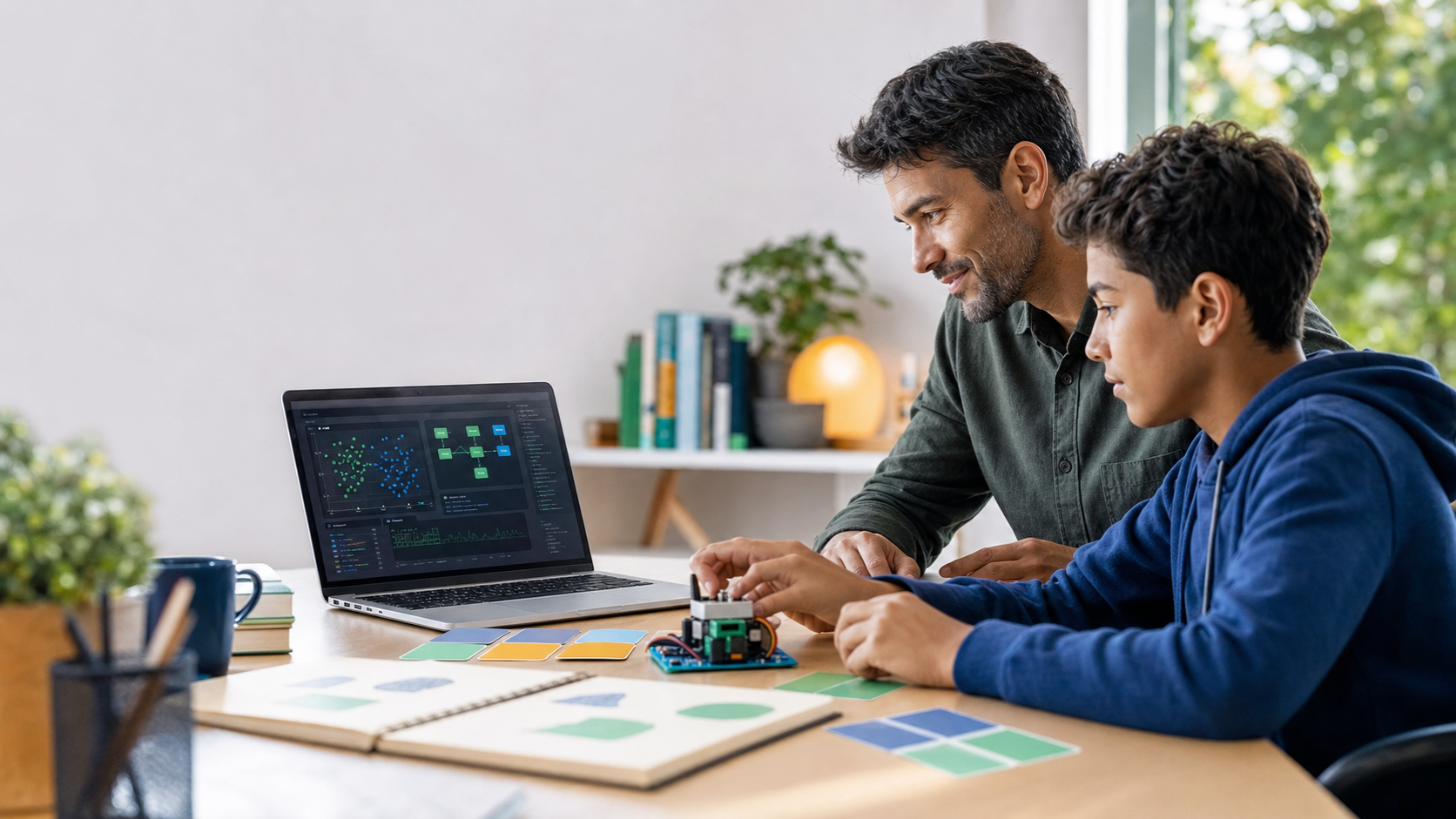
Machine learning helps move AI education beyond hype.
Many children now hear that AI can write, draw, chat, summarize, code, and solve problems. But if AI is only presented as a magic answer machine, students miss the most important idea: modern AI systems are built from data, patterns, predictions, testing, and human judgment.
Machine learning gives parents and students a more grounded way to talk about AI.
Instead of asking, "Can this tool do my homework?" a student can ask:
- What data did the system learn from?
- What pattern is it trying to recognize?
- What prediction is it making?
- How could the prediction be wrong?
- How would we test whether it works?
Those questions are much more valuable than memorizing AI buzzwords.
They also connect directly to the skills students need in modern AI classes for kids, Python for Kids, coding classes for kids, and broader online STEM classes. A child does not need to become a professional data scientist at age ten. But they should begin understanding that AI is not magic. It is a technical system that can be explored, questioned, and improved.
That is why machine learning is becoming a serious part of K-12 AI literacy. The AI4K12 initiative organizes artificial intelligence learning around five big ideas, including the idea that computers can learn from data. The 2025 State of AI and Computer Science Education report tracks AI education alongside computer science policy, access, and teacher preparation. In February 2026, ISTE+ASCD and Google announced AI literacy training for six million U.S. educators, with an emphasis on pedagogy, ethics, and critical thinking.
For parents, the opportunity is not to rush children into advanced algorithms. The opportunity is to help them understand AI with enough clarity that they can use it thoughtfully and build with it responsibly.
Quick Answer: What Is Machine Learning For Kids?
Machine learning for kids means teaching students, in an age-appropriate way, how computers can use data to find patterns and make predictions.
A simple explanation:
Machine learning is a type of AI where a computer learns from examples instead of being given every rule by hand.
For example:
- A spam filter learns patterns from many messages labeled "spam" or "not spam."
- A recommendation system learns patterns from what people watch, click, or buy.
- A handwriting recognizer learns from many examples of written letters and numbers.
- A beginner image classifier can learn from examples of different objects.
- A simple prediction model can look at data and estimate what might happen next.
For kids, the important idea is not the math behind every model. The important idea is the learning loop:
- Collect examples.
- Label or organize the data.
- Train a model to find patterns.
- Test the model with new examples.
- Look for mistakes.
- Improve the data, model, or question.
That loop teaches data literacy, coding logic, scientific thinking, and AI judgment.
Machine Learning vs AI: The Parent-Friendly Difference
Parents often hear "AI" and "machine learning" used as if they mean the same thing. They are related, but not identical.
Artificial intelligence is the broader field of making computers perform tasks that seem intelligent: reasoning, perception, language, planning, problem solving, and interaction.
Machine learning is one way to build AI systems. Instead of writing every rule manually, engineers give a model examples so it can learn patterns from data.
Here is a practical way to explain it to a student:
- Traditional program: "If this exact rule happens, do this exact thing."
- Machine learning model: "Here are many examples. Find the pattern and make a prediction for a new example."
That difference matters.
If a child writes a simple Python program that says:
if temperature > 80:
    print("It is hot outside")
the rule is written directly by the student.
If a machine learning model looks at thousands of weather records and learns patterns that predict whether a day will feel hot, the rule is learned from data.
Both approaches require thinking. But machine learning adds new questions:
- Was the data fair and useful?
- Were the labels accurate?
- Did the model see enough examples?
- Does it work on new cases, or only on the training data?
- What happens when the model is confident but wrong?
That is why machine learning belongs in AI literacy, not just advanced computer science.
Why Kids Should Learn How AI Learns
Many children already interact with AI systems before they understand them.
They see recommendations on video platforms. They use search engines. They play games with adaptive systems. They may use chatbots, image generators, grammar tools, homework helpers, or AI features inside school platforms.
Without machine learning literacy, these systems feel invisible.
A student may think:
- "The app knows what I like."
- "The chatbot sounds confident, so it must be right."
- "The recommendation is popular, so it must be good."
- "AI is smarter than me."
Machine learning changes the conversation.
The student begins to understand that the system learned from data, the data may be incomplete or biased, the prediction is not the same as truth, the model can make mistakes, and a human still needs to evaluate the output.
This is one reason the World Economic Forum Future of Jobs Report 2025 highlights AI and big data, technological literacy, analytical thinking, and related technical skills as increasingly important. Students do not need career pressure loaded onto childhood. But they do need a realistic understanding of the technical world they are growing into.
Machine learning also helps kids build better mental habits: curiosity about patterns, skepticism about predictions, precision about the problem, awareness of useful examples, and responsibility for how mistakes affect people.
Those habits matter whether a student becomes a programmer, designer, scientist, entrepreneur, doctor, analyst, educator, or informed citizen.
What Age Should Kids Start Machine Learning?
Kids can start learning machine learning concepts earlier than many parents think, as long as the format matches their age. The goal is not to teach advanced statistics too soon. The goal is to build a path from pattern recognition to real technical understanding.
Ages 7-9: Patterns, Sorting, And Predictions
Younger students can begin with unplugged activities: sorting objects by features, making predictions from examples, comparing categories, and explaining what information helped them decide.
Example:
Give a child a set of cards with imaginary animals. Some can fly and some cannot. Ask the child to look for patterns. Do animals with wings always fly? Are there exceptions? What feature is most useful? What would they predict about a new animal card?
That is not formal machine learning, but it introduces the core idea: examples can help us make predictions.
Ages 10-12: Simple Data Projects And Beginner Code
This is a strong age range for connecting machine learning ideas to coding. Students can work with small, safe datasets and learn vocabulary such as data, label, feature, model, prediction, training, testing, and accuracy.
They can also begin using Python to count examples, store labels, compare categories, make charts, test rules, and build a small text-based classifier before using real ML tools.
This is where Python projects for kids and data science for kids become useful stepping stones. Students learn that AI is built on code and data, not only prompts.
Ages 13-18: Models, Ethics, Evaluation, And Real Projects
Teens can compare model outputs, inspect mistakes, build small portfolio projects, and discuss responsible use. They can learn why training data matters, why testing on new examples matters, and why an accurate model can still be inappropriate for a sensitive use case.
For teens, machine learning connects naturally to:
- Python notebooks.
- Data visualization.
- Web apps that use AI features.
- Robotics sensors and classification.
- Cybersecurity detection examples.
- AI product prototypes.
- Portfolio-ready technical explanations.
That last point matters. A teen who can explain how a model was trained, tested, and limited has stronger proof of skill than a teen who only says, "I used AI."
Beginner Machine Learning Concepts Kids Should Know
Machine learning becomes less intimidating when students learn a small set of concepts clearly.
Data
Data is the information a model learns from.
For kids, data can be simple:
- A list of favorite books and genres.
- Weather observations.
- Plant growth measurements.
- Game scores.
- Images sorted into categories.
- Short text examples labeled by topic.
The key lesson is that better data usually leads to better learning. Messy, incomplete, private, or unfair data can cause problems.
Labels
A label tells the model what an example is.
If students are training a model to recognize recyclable items, the examples might be labeled "paper," "plastic," "metal," or "not recyclable."
Labels can be wrong. That is a powerful lesson for kids. If the training examples are mislabeled, the model can learn the wrong pattern.
Features
Features are the details the model uses to make a prediction.
For a simple fruit example, features might include color, size, shape, texture, or weight.
Students can ask:
- Which feature matters?
- Which feature is distracting?
- Which feature might accidentally create unfair results?
This connects to computational thinking for kids, especially abstraction: choosing what information matters and ignoring what does not.
Model
A model is the system that learns from examples.
For beginners, parents can explain a model as "the part that studies the examples and tries to make a good prediction for a new example."
Students do not need to understand neural networks right away. They should first understand that a model is trained, tested, and improved.
Prediction
A prediction is the model's guess for a new example.
Predictions are not facts. They can be useful, uncertain, biased, or wrong.
This is one of the most important AI literacy lessons for kids.
Accuracy And Mistakes
Accuracy is one way to measure how often the model is right. But accuracy is not the whole story. A model might be mostly accurate overall while still failing for a smaller group of examples. A model might be accurate in a practice setting but unreliable in real life.
Kids can understand this with simple examples:
If a model is trained only on pictures of red apples, it may struggle with green apples. If a model learns from only one student's handwriting, it may not work well for someone else.
That is not a reason to fear AI. It is a reason to test it carefully.
Beginner Machine Learning Projects For Kids
Good beginner projects should be small, safe, explainable, and connected to real student curiosity.
1. The Sorting Rule Challenge
Before using a machine learning tool, ask the student to create their own classification rule. Can they classify school supplies as "writing tool," "paper item," or "other" based on features?
The student writes rules first, then tests examples that break the rules. This builds classification intuition without advanced tools.
2. A Simple Recommendation System
Students can make a tiny recommendation system using a spreadsheet or Python list. They choose a category such as books, games, or music, then define features such as genre, difficulty, length, mood, or topic.
This helps students understand that recommendations are built from data and rules before they compare that with systems that learn from large amounts of behavior data.
3. Image Classifier With Safe Objects
Older kids can train a beginner image classifier using non-sensitive objects such as school supplies, recyclable items, or household shapes.
The important part is not the wow factor. The important part is the test: does it work with new examples, what mistakes does it make, did lighting or background change the result, and did the model have enough examples?
4. Weather Or Plant Growth Prediction
A student can collect observations over time, such as temperature, rainfall, sunlight, or plant height. The project can start with charts before any formal model: what changed, what pattern appeared, what prediction would we make next, and how confident are we?
This is a strong bridge between STEM learning at home and data science.
5. AI Output Testing Lab
Students can compare outputs from an AI tool and score them with a checklist: correct, complete, safe, age-appropriate, clear about assumptions, and ready for human verification.
This connects machine learning to AI literacy for kids, prompt engineering for kids, and responsible technical judgment.
What Parents Should Watch For
Machine learning can be an excellent learning topic, but not every AI activity is equally useful. Look for experiences where the student can describe the problem, use age-appropriate data, avoid private uploads, compare training examples with test examples, inspect mistakes, and explain where the model may fail.
Be cautious when an activity is mostly button-clicking, treats predictions as truth, skips testing, or leaves the student unable to explain what changed after training.
Parents do not need to understand every algorithm. Ask one question: "Can my child explain what the system learned from and how they tested it?"
How Machine Learning Connects To Coding
Machine learning is not separate from coding. It sits on top of many coding and data skills.
Students who learn Python, JavaScript, logic, debugging, and project design are better prepared to understand AI systems because they already know how technical instructions work.
Python is especially useful because it is widely used in data, automation, and AI education. A beginner does not need advanced libraries immediately. They can start by writing programs that store examples, compare values, count categories, and test simple prediction rules.
For example, before training a model, a student might write a program that classifies movies by age rating, length, and genre. Then they can discuss why a hand-written rule is different from a model that learns from many examples.
It helps students see that AI is not replacing logic. It is adding a new layer where data, probability, and evaluation matter.
This is also why vibe coding for kids needs boundaries. AI-assisted coding can help students explore faster, but machine learning literacy helps them ask what the tool is doing, what it may be assuming, and what needs to be tested.
A Parent Checklist For Machine Learning Classes
If you are comparing machine learning, AI, or coding programs for a child, look for plain-language explanations, real coding or structured technical reasoning, data privacy rules, beginner projects with clear inputs and tests, discussion of bias and limitations, chances for students to explain their thinking, and parent visibility into what the child is building.
Be cautious of programs that promise a child will "master AI" in a weekend. Machine learning is best learned as a sequence: pattern intuition, beginner coding logic, simple data, small models, mistake analysis, and projects that explain the learning process.
How Generation STEM Approaches AI Learning
Generation STEM treats AI learning as part of a broader technical education path.
Students need to understand tools, but they also need to build.
That means connecting AI concepts to:
- Coding fundamentals.
- Python projects.
- Data and visualization.
- Computational thinking.
- Responsible prompting.
- Debugging and testing.
- Age-appropriate project work.
For families looking for a structured path, AI classes for kids help students build safe AI literacy and project habits, while coding classes for kids and Python for Kids build the programming foundation that makes AI less mysterious.
Machine learning becomes most valuable when students can say:
"Here is the data. Here is what the model tried to predict. Here is how I tested it. Here is where it made mistakes. Here is what I changed."
That is not hype. That is real technical understanding.
FAQ
What is machine learning in simple words for kids?
Machine learning is a type of AI where a computer learns patterns from examples and uses those patterns to make predictions about new examples.
Is machine learning too advanced for kids?
The advanced math can wait, but the core ideas are appropriate for kids when taught with simple examples: data, labels, patterns, predictions, testing, and mistakes.
Should kids learn machine learning before coding?
Kids can learn basic machine learning concepts before coding, but coding makes the ideas stronger. Python, logic, debugging, and data projects help students understand how AI systems are built and tested.
What is a good first machine learning project for kids?
A good first project is a small classification or prediction activity with safe data, such as sorting objects, making simple recommendations, or testing an image classifier on school supplies or recyclable items.
How is machine learning different from ChatGPT?
ChatGPT is an AI tool built using large-scale machine learning. Machine learning is the broader technical idea of training models from data. Kids can use ChatGPT, but they should also learn how AI systems can learn, predict, and make mistakes.
What should parents avoid in kids' machine learning projects?
Avoid projects that upload private information, use sensitive personal images, treat AI predictions as facts, skip testing, or focus only on impressive outputs without helping the student explain how the system works.
Suggested Related Articles
- AI Literacy for Kids: The Chatbot Rules Parents Should Teach First
- Data Science for Kids: Why Data Literacy Matters in the AI Era
- Python Projects for Kids: Beginner Ideas That Build Real Coding Skill
- Computational Thinking for Kids: The Problem-Solving Skill Behind Coding and AI
Sources
- AI4K12: Sparking Curiosity in AI
- 2025 State of AI and Computer Science Education Report
- ISTE+ASCD and Google AI Literacy Training Announcement
- World Economic Forum Future of Jobs Report 2025: Skills Outlook
Start Building Real AI Understanding
If your child is curious about AI, do not stop at chatbot shortcuts. Help them learn the code, data, testing habits, and judgment behind modern tools.
Explore AI classes for kids, start with Python for Kids, or compare the broader Generation STEM course path to find the right next step.