
Deepfake Literacy for Kids: How Parents Can Teach AI Media Verification
Deepfake literacy helps kids question AI-generated images, videos, voices, and screenshots before they trust, share, or react.
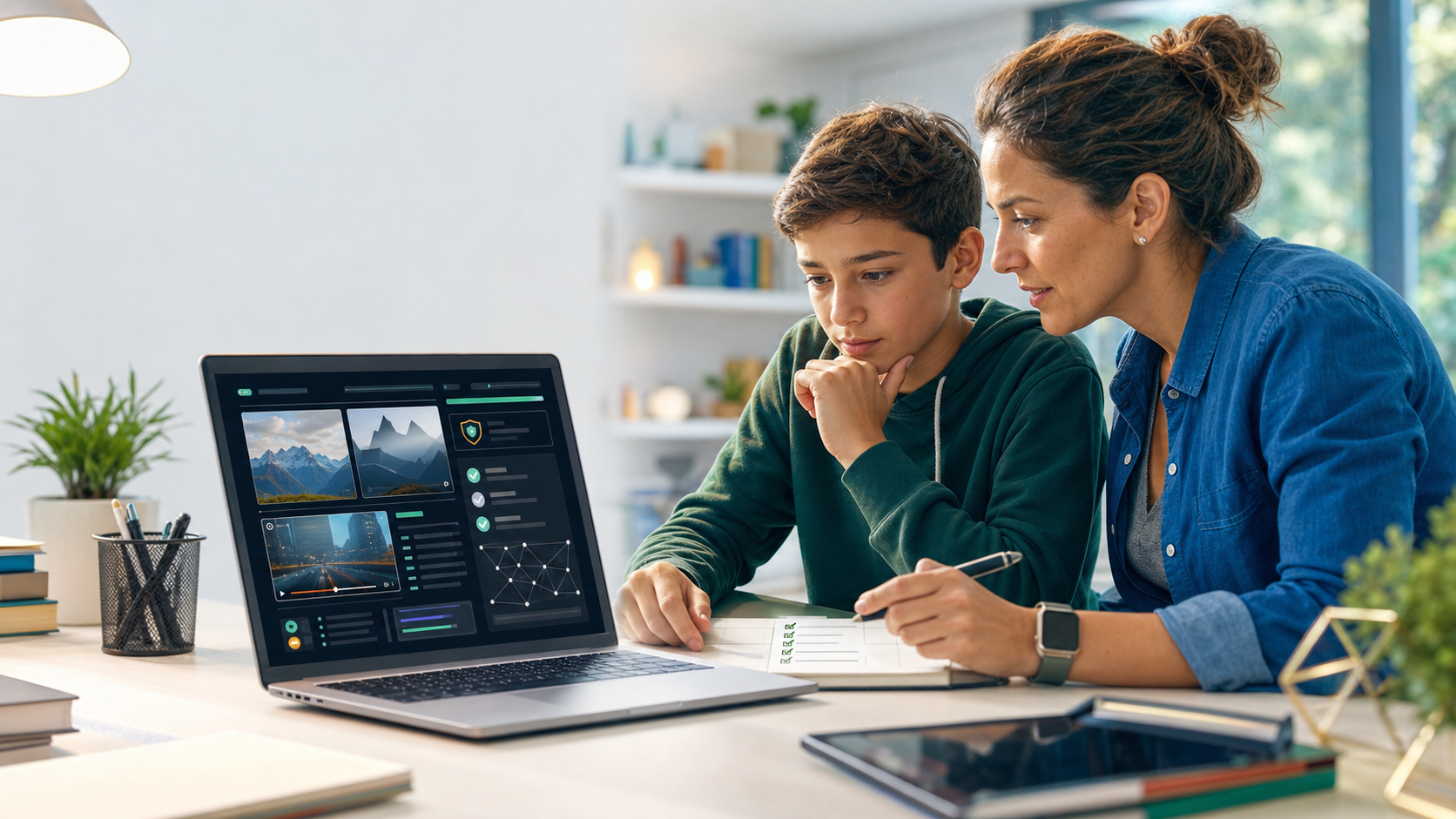
Deepfake literacy for kids is becoming one of the most important parts of AI education.
Children now encounter AI-generated images, edited screenshots, synthetic voices, realistic avatars, fake videos, scam messages, and AI-written posts in the same feeds where they talk with friends, watch creators, do school research, and follow news. A child does not need to become a forensic analyst. But they do need a reliable habit: pause before believing, sharing, forwarding, or reacting.
That habit matters because deepfakes are no longer rare or obviously strange. Generative AI tools can create media that looks polished enough to fool a quick glance. They can also make fake content emotionally powerful: a celebrity "says" something shocking, a classmate "appears" in an image, a voice note sounds urgent, or a screenshot seems to prove a rumor.
For families comparing AI classes for kids, cybersecurity for kids, coding classes for kids, or broader online STEM classes, deepfake literacy should sit near the center of the curriculum. It connects AI, privacy, media literacy, online safety, and technical judgment.
The goal is not fear. The goal is competence.
Quick Answer: What Is Deepfake Literacy For Kids?
Deepfake literacy for kids is the ability to understand that digital media can be generated or manipulated by AI, then use age-appropriate verification steps before trusting or sharing it.
For children and teens, deepfake literacy includes:
- Knowing that images, videos, voices, screenshots, and messages can be fake even when they look real.
- Checking the source before reacting.
- Looking for context, not just visual clues.
- Understanding privacy and consent when photos or voices are involved.
- Reporting harmful or embarrassing AI-generated content instead of forwarding it.
- Asking a trusted adult when a piece of media feels urgent, threatening, humiliating, or too good to be true.
- Building enough technical understanding to see AI as a system, not magic.
This is a practical skill. A student should be able to use it during homework research, group chats, gaming communities, social media, and creative projects.
Why Parents Are Asking About Deepfakes Now
Deepfakes used to sound like an adult political or celebrity problem. That is no longer accurate.
Students are using AI tools, classmates are experimenting with image generators, social platforms are filling with synthetic media, and online scams are becoming more realistic. Pew Research Center reported in February 2026 that 64% of U.S. teens said they use AI chatbots, while a smaller share of parents said their own teen uses them. That gap matters: many kids are already in AI-shaped spaces before families have agreed on rules.
Microsoft's Safer Internet Day 2026 guidance framed the same issue around students becoming AI-aware, safe, smart, and in control. It emphasized content shaped by AI, manipulative interactions, misinformation, personal data, and digital identity as part of modern digital citizenship.
The trend is also tied to future skills. The World Economic Forum's Future of Jobs 2025 work points to fast-growing demand for AI, big data, cybersecurity, analytical thinking, and technological literacy. For students, that does not mean rushing into professional-level AI tools. It means learning to inspect digital systems carefully.
Deepfake literacy is where future-readiness and online safety meet.
The Verification Habit: Pause, Source, Context, Confirm
The most useful deepfake rule for kids is short enough to remember:
Pause, source, context, confirm.
Pause
Deepfakes and scams often work by making people react quickly. The content may be funny, embarrassing, shocking, urgent, flattering, or frightening. That emotional pressure is the first signal to slow down.
Teach kids to ask:
- Is this trying to make me panic, laugh at someone, feel special, or click quickly?
- Would sharing this hurt someone if it is fake?
- Do I know where it came from?
- Do I need an adult before doing anything?
The pause is the protective skill. It keeps a child from becoming part of the spread.
Source
Kids should learn to separate the media from the account that shared it.
An image posted by a random account is not the same as an image published by a school, a known news source, a verified organization, or the person actually involved. A screenshot in a group chat is not proof. A video without a traceable original is not proof. A voice message from an unfamiliar account is not proof.
Good source questions include:
- Who originally posted this?
- Can I find the same information on the real website or official account?
- Is the account new, anonymous, copied, or pretending to be someone else?
- Is there a link to a real source, or only a dramatic caption?
This does not mean children need to distrust everything. It means they should know that trust comes from context.
Context
Deepfakes often hide context. A fake image may be cropped to remove clues. A real video may be clipped to change the meaning. A screenshot may omit the message before it. An AI voice may imitate someone without showing when or where it was recorded.
Teach students to look beyond the frame:
- What happened before and after this clip?
- When was it supposedly made?
- Where did it supposedly happen?
- Is anyone reputable reporting the same thing?
- Does the caption make a bigger claim than the media actually proves?
Context checking is a media literacy skill, but it also builds technical reasoning. Students learn that evidence has boundaries.
Confirm
Confirmation means using another path before acting.
If the media is about a school announcement, check the school website or teacher message. If it is about a friend, ask the friend privately through a known channel. If it is about news, compare reliable sources. If it is about a celebrity, public figure, product, or emergency, look for official statements and reputable coverage.
For younger children, the confirmation step can be simple: "Bring it to an adult before sharing." For older students, it can become a more independent research habit.
Visual Clues Can Help, But They Are Not Enough
Many deepfake guides tell kids to look for strange hands, odd shadows, blurred backgrounds, mismatched earrings, weird reflections, or unnatural blinking. Those clues can help, especially with low-quality AI media.
But families should not rely on visual clues alone.
AI media keeps improving, and real media can also look strange because of lighting, compression, filters, low-resolution video, or motion blur. A deepfake literacy habit that depends only on spotting weird details will age quickly.
A stronger approach combines visual checks with source checks:
- Look closely at the image or video.
- Check who posted it.
- Search for the original source.
- Compare against reliable coverage.
- Ask whether the claim matters enough to verify.
- Avoid sharing if the answer is uncertain.
This is the difference between "spot the fake" and "build verification judgment." The second skill lasts longer.
What Kids Should Know About AI Voices
AI voice cloning creates a special challenge because voices feel personal. A child may trust a voice note more than a text message because it sounds like a real person.
The rule should be clear: a voice can sound familiar and still be fake.
This matters in several scenarios:
- A message claims to be from a friend asking for a code, login, gift card, or private photo.
- A voice note says a parent needs help urgently.
- A clip of a teacher, coach, creator, or public figure spreads with a shocking claim.
- A game or social account uses audio to pressure a child into acting quickly.
Families can create a simple verification rule for urgent requests. If a message asks for money, passwords, photos, location, account codes, or secrecy, the child should confirm through a known trusted channel before responding. Younger kids should bring it to an adult immediately.
This is not only AI literacy. It is cybersecurity.
The Privacy Rule: Photos And Voices Are Personal Data
Deepfake literacy is not only about consuming media. It is also about what kids upload.
Children should understand that photos, videos, voice clips, usernames, school names, team uniforms, room backgrounds, and friend group images can reveal more than they expect. Once media is uploaded, copied, or shared, the child may not control where it goes next.
That does not mean kids can never create online. It means families need rules:
- Do not upload someone else's face or voice to an AI tool without permission.
- Do not use AI to embarrass, impersonate, sexualize, bully, or threaten another person.
- Do not paste private screenshots, school records, group chats, or personal photos into AI tools.
- Do not forward humiliating AI-generated content, even to ask "is this real?"
- Save evidence and ask for help if harmful content appears.
The consent rule is especially important. A child who would never physically take something from a classmate may still think an AI edit is a joke. Parents and teachers need to make the boundary explicit: a person's face, voice, body, and identity deserve respect.
What To Do If A Deepfake Targets A Child
Families need a response plan before something goes wrong.
If a child sees, receives, or becomes the target of harmful AI-generated content, the first parent response should be calm. Shame and panic can make children hide problems. The priority is safety, documentation, reporting, and support.
A practical response:
- Do not reply to threats or forward the content.
- Preserve evidence with adult help when appropriate.
- Report the post, account, or message through the platform.
- Contact the school if classmates are involved.
- Change passwords and secure accounts if impersonation or account access may be involved.
- Use official reporting and removal resources when content is intimate, exploitative, threatening, or illegal.
- Tell the child clearly that asking for help was the right move.
The FBI continues to warn families about online exploitation and sextortion schemes involving minors. The FTC also notes that the TAKE IT DOWN Act covers certain nonconsensual intimate images, including AI-generated "digital forgeries," and creates removal-request obligations for covered platforms. Parents should use trusted official resources and local guidance when the situation is serious.
The deeper lesson for children is simple: reporting is not tattling, and asking for help is not failure.
How Deepfake Literacy Connects To Coding And AI Classes
Deepfake literacy becomes stronger when students understand how technology is built.
A child does not need to train a model from scratch to understand the basics. They can learn that AI systems generate outputs from patterns, prompts, examples, data, and probabilities. They can learn that tools can be useful and still make mistakes. They can learn that every digital product has inputs, outputs, users, incentives, and failure modes.
That is why deepfake literacy fits naturally with AI classes for kids. Students should not only ask AI for answers. They should learn how to evaluate outputs, protect privacy, and think about responsible use.
It also connects to Python for Kids. Coding teaches students to test assumptions. A program either behaves as expected or it does not. Students learn to inspect, debug, change one variable, run again, and explain the result. That mindset transfers directly to media verification: inspect the claim, check the source, compare evidence, and revise your belief.
For older students, Ethical Hacking can build on the same habit. Cybersecurity is not just about tools. It is about trust, identity, permissions, evidence, and responsible action.
A Family Deepfake Literacy Checklist
Use this checklist when a child sees an image, video, voice note, screenshot, or post that feels surprising, urgent, embarrassing, or important.
- What is the claim? Say exactly what the media is trying to prove.
- Who shared it first? Look for the original source, not only the person who forwarded it.
- Can we verify it somewhere reliable? Check an official site, trusted news source, school channel, or known person.
- What context is missing? Ask what happened before, after, and outside the frame.
- Could sharing hurt someone? If yes, do not forward it.
- Is private information involved? Photos, faces, voices, locations, school names, and messages deserve extra care.
- Do we need adult help? Anything threatening, sexual, humiliating, or coercive should involve a trusted adult immediately.
Families can keep the language consistent: "We do not share before we verify."
What Parents Should Look For In AI Media Literacy Education
Good AI media literacy education should be active, not just a warning poster.
Look for learning experiences that help students:
- Compare real, edited, and AI-generated examples without shaming students.
- Practice source checking and claim checking.
- Understand privacy, consent, and digital identity.
- Discuss when AI creativity is appropriate and when it becomes harmful.
- Build small projects that make AI systems less mysterious.
- Use age-aware guardrails and parent-visible progress.
- Connect AI literacy to coding, cybersecurity, and responsible product thinking.
Be cautious with programs that treat AI as either magic or disaster. Both extremes miss the point. Students need a realistic framework: AI tools are powerful, useful, imperfect, and socially consequential. They require human judgment.
Generation STEM is built around that kind of learning. Students work in browser-based technical environments, receive Nova AI guidance, build real projects, and practice the reasoning habits that make technology safer and more useful. Families can explore AI classes for kids, compare coding classes for kids, or review family pricing when they are ready for a structured path.
FAQs
What is a deepfake?
A deepfake is AI-generated or AI-manipulated media that makes a person, event, voice, image, or video appear different from reality. Deepfakes can be used for entertainment, but they can also be used to mislead, impersonate, bully, scam, or harm people.
How can kids spot deepfakes?
Kids can look for visual clues, but the stronger habit is verification. They should pause, check the original source, look for missing context, compare reliable sources, and ask an adult before sharing anything urgent, embarrassing, or suspicious.
Are deepfakes dangerous for kids?
They can be. Deepfakes can spread misinformation, impersonate trusted people, pressure children into unsafe actions, or create harmful fake images. The best response is age-appropriate AI literacy, privacy rules, source checking, and a clear plan for reporting harmful content.
Should kids use AI image or video tools?
Kids can use creative AI tools safely when the tool is age-appropriate, the activity is supervised, and the rules are clear. They should not upload other people's faces or voices without permission, create embarrassing or sexualized content, or treat AI-generated media as automatically true.
What should parents do if a child is targeted by a deepfake?
Stay calm, do not forward the content, preserve evidence with adult help, report it through the platform, involve the school if students are involved, secure accounts if needed, and use official reporting resources when the content is threatening, exploitative, intimate, or illegal.
Suggested Related Articles
- AI Literacy for Kids: The Chatbot Rules Parents Should Teach First
- Cybersecurity for Kids: Online Safety Skills Parents Should Teach Early
- Prompt Engineering for Kids: How to Ask AI Better Questions Without Replacing Thinking
- Machine Learning for Kids: A Parent Guide to AI That Learns From Data
Sources
- Pew Research Center: How Teens Use and View AI
- Microsoft Education: Safer Internet Day 2026
- World Economic Forum: Future of Jobs Report 2025
- Stanford SCALE Initiative: The Evidence Base on AI in K-12
- FBI: Sextortion safety resources
- FTC: TAKE IT DOWN Act enforcement
Start Building Safer AI Judgment
Deepfake literacy is not a single conversation. It is a habit families can practice every time a child sees surprising media online: pause, source, context, confirm.
If your child is ready to move from AI curiosity to structured technical confidence, explore AI classes for kids, start with Python for Kids, or compare Generation STEM coding classes. The strongest students will not be the ones who believe nothing. They will be the ones who know how to verify, build, and explain.