
AI Voice Scams and Kids: A Family Verification Plan for 2026
A practical parent guide to AI voice scams: how voice cloning changes family-emergency fraud, why listening for glitches is not enough, and the verification habits every child should practice.
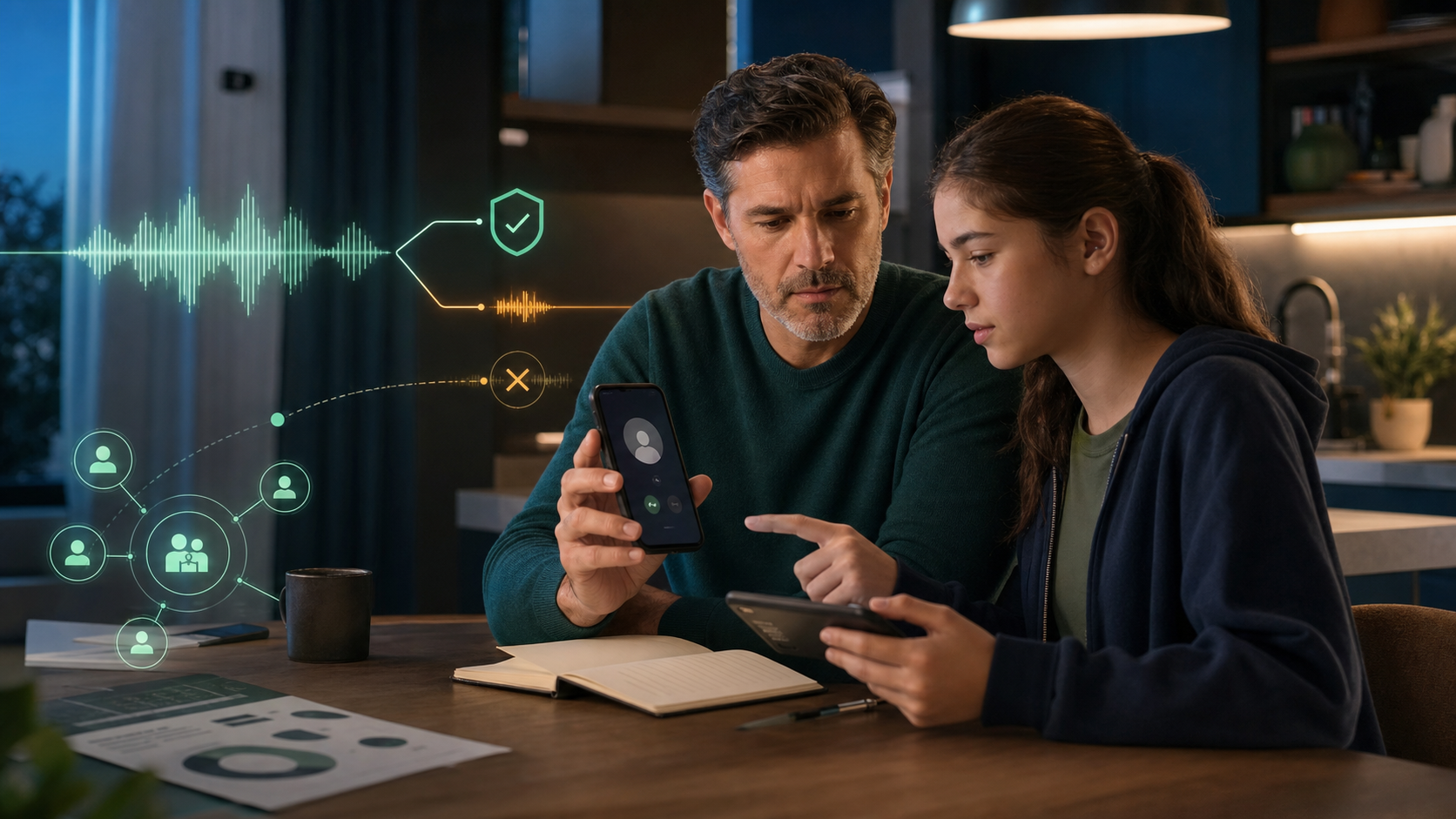
AI voice scams change one of the oldest family safety assumptions: hearing a familiar voice is no longer proof that a familiar person is calling.
A scammer may claim that a child has been injured, arrested, stranded, or locked out of an account. The caller may sound frightened. They may know the child's name, school, sport, relatives, or recent trip. They may demand secrecy and immediate payment. With voice-cloning tools, they may even sound enough like the child to short-circuit a parent's usual skepticism.
Children can be targeted too. A caller or voice message might imitate a parent, coach, teacher, or friend and ask the child to share a code, click a link, move to another messaging app, disclose where someone is, or send money.
The right response is not panic, and it is not a contest to identify tiny audio glitches. It is a repeatable verification process that every family member can use under pressure.
For families already teaching AI literacy, online safety, or technical skills through AI classes for kids, voice-scam readiness is a practical extension of the same principle: understand what a system can generate, then design a safer way to make decisions around it.
Quick Answer: How Should Families Handle AI Voice Scams?
Treat any urgent request for money, credentials, location information, or secrecy as unverified—even when the voice sounds exactly like someone you know.
Use this five-step response:
- Pause. Do not pay, share a code, click a link, or reveal information.
- End the call or stop replying to the message.
- Call the person back using a number already saved in your contacts.
- Check with a second trusted person through a separate channel.
- Report and preserve the suspicious message after everyone is safe.
Families should also choose a private verification phrase and practice the plan before an emergency happens. The plan matters more than the realism of the voice.
What Is an AI Voice Scam?
An AI voice scam uses synthetic or manipulated audio to make an impersonation more convincing. It may involve a full voice clone, generated speech that resembles a real person, an edited recording, or a human scammer supported by spoofed caller ID and personal information gathered online.
Voice phishing is often called vishing. Like phishing by email or smishing by text, vishing tries to create enough trust or fear that the target takes an unsafe action. The technical delivery changes, but the social engineering pattern is familiar:
- Impersonate someone trusted.
- Create urgency, fear, authority, or secrecy.
- Prevent the target from checking the story.
- Request money, access, information, or a risky action.
The FBI has warned that malicious actors increasingly use AI-generated audio to impersonate public figures and personal contacts. The agency's guidance emphasizes independent verification because synthetic audio can be difficult to identify by sound alone.
That distinction is important. A voice clone does not need to be perfect. It only needs to be believable during a stressful moment.
How Voice-Cloning Family Scams Work
The Federal Trade Commission explains that a scammer may obtain a short audio clip from material posted online and use voice-cloning software to imitate a loved one. Audio could come from a public video, livestream, podcast, social post, gaming chat clip, school performance, or another shared recording.
The voice is only one layer of the attack. A convincing attempt may combine:
- A cloned or edited voice.
- Caller ID spoofing or a new messaging account.
- Names and relationships collected from social media.
- Public details about a school, team, workplace, or travel plan.
- A plausible emergency story.
- An authority figure such as a fake lawyer, police officer, doctor, coach, or administrator.
- A payment request using gift cards, cryptocurrency, a wire transfer, or a payment app.
This is why “but they knew our details” is not reliable proof. Personal context can be collected, guessed, purchased, or exposed through another account. The safer question is whether the request survives independent verification.
Why Listening for a Fake Voice Is Not Enough
Many safety lists tell people to listen for robotic pacing, strange breaths, mismatched emotion, background noise, or awkward pronunciation. Those clues may justify caution, but they should never be the family's main defense.
Modern generated speech can reproduce pauses, emotional tone, filler words, and natural cadence. A 2026 controlled study of synthetic voices in realistic vishing scenarios found that its small participant group could not reliably distinguish AI-generated clips from human recordings. The study is limited by its sample size, but its practical lesson matches federal guidance: surface-level voice clues are not a dependable authentication system.
The opposite error matters too. A real family member may sound unusual because of stress, an injury, a weak connection, medication, background noise, or a borrowed phone. Families should not try to “prove AI” from the audio. They should verify the identity and story through a known channel.
Use audio clues as a reason to pause, never as a reason to proceed.
The Pressure Signals Kids and Parents Should Recognize
AI voice scams are usually easier to recognize by the requested behavior than by the audio quality.
“Do it right now”
Urgency reduces careful thinking. A real emergency can be urgent, but legitimate helpers will not object to a brief identity check or a callback to an official number.
“Do not tell anyone”
Secrecy isolates the target from people who could expose the story. The FTC specifically identifies pressure to keep a family emergency secret as a scam signal.
“Use this unusual payment method”
Gift cards, cryptocurrency, wire transfers, and payment-app transfers can be difficult to reverse. A child should never handle an emergency payment request alone.
“Read me the code”
One-time passcodes and multifactor authentication codes protect accounts. A caller asking for one may be trying to complete a login or account takeover. No family member, school employee, or support agent needs a child's private sign-in code.
“Click this link or switch apps”
A scammer may move the conversation to a platform they control or send a credential-stealing link. The FBI advises independently confirming the sender before opening links or downloading anything.
“I cannot answer your question”
An impersonator may deflect a verification question, claim there is no time, or hand the call to a fake authority figure. Pressure is not verification.
Build a Family Verification Plan Before You Need It
A strong plan should be short enough for a child to remember and specific enough to use during stress.
1. Choose the default rule
Make the rule explicit:
No family member will be upset if you pause an urgent call and verify it another way.
Children need permission to hang up on someone who sounds like an adult they know. Grandparents and caregivers need the same permission when the voice sounds like a child they love.
2. Create a private family phrase
Choose a phrase that is memorable but not publicly associated with the family. Do not use a pet name, birthday, address, school mascot, or detail visible on social media.
A family phrase is useful as one signal, not as the only defense. If it is spoken aloud, shared in an insecure message, or disclosed during a scam attempt, replace it. Never turn the phrase into a universal password for online accounts.
3. Define trusted callback routes
Each family member should know which saved numbers to call:
- The person who supposedly contacted them.
- A parent or caregiver.
- A second relative or trusted adult.
- The school, camp, workplace, hospital, or local authority using an independently found official number.
Do not call a number supplied by the suspicious caller. Do not trust caller ID as proof.
4. Set money and account rules
Families can remove ambiguity with firm defaults:
- Kids never send money or gift-card codes because of an unexpected call.
- Kids never share passwords, verification codes, or recovery links.
- Adults verify financial requests through a known channel and a second person.
- Nobody moves money to “protect” it because a caller says an account is at risk.
5. Decide what information stays private
Children should not confirm their location, schedule, household members, travel, school details, or whether an adult is home to an unverified caller. A scammer can use small answers to improve the current story or prepare a later attack.
A Script Kids Can Actually Use
Safety advice works better when children have exact words available.
For a suspicious call:
“I do not handle urgent requests on calls. I am hanging up and contacting my parent.”
For a familiar-sounding voice:
“I need to call you back on the number I already have.”
For a code request:
“I never share sign-in or verification codes.”
For pressure to keep a secret:
“I do not keep safety or money requests secret from my family.”
The child does not need to accuse the caller, investigate the technology, or win an argument. Ending the interaction is enough.
Practice With a Five-Minute Family Drill
Role-play one realistic scenario every few months. Keep it calm and brief.
One adult pretends to be a caller saying a parent lost a phone and needs the child to read a code. The child practices pausing, refusing, ending the call, and contacting a trusted adult through a saved route.
Then reverse the scenario. Pretend a grandparent receives a call from someone who sounds like a teenager asking for secret emergency money. Practice the callback and second-person check.
Afterward, ask:
- What created pressure?
- What information was the caller requesting?
- Which channel did you use to verify?
- Who was the second trusted person?
- What would you save or report?
This builds the same kind of procedural thinking students use in cybersecurity projects: identify the threat model, define trusted inputs, test the process, and improve weak points.
Reduce the Audio and Personal Data Available to Scammers
Privacy cannot eliminate voice scams, and families should not blame a child whose public clip is misused. Still, reducing unnecessary exposure can make impersonation harder and limit the personal details available for a convincing script.
Review:
- Which social profiles are public.
- Whether videos reveal full names, schools, teams, schedules, or travel.
- Who can download, remix, or share a child's recordings.
- Whether gaming and chat accounts expose real-world identity.
- Which old public clips can be removed.
- Whether family posts reveal relationships and nicknames.
Parents should model the same restraint. A public birthday post, vacation update, school announcement, and speaking video can provide more context together than any one post appears to reveal.
The goal is not to erase a child's creative work from the internet. It is to publish deliberately and understand that voices, faces, locations, and relationships are valuable identity data.
What to Do During a Suspected AI Voice Scam
If a suspicious call arrives:
- Do not send money or information.
- Write down the claim without offering extra details.
- End the call.
- Contact the person through a known number or account.
- Ask a second trusted person to verify the situation.
- If the caller claims to represent an organization, contact that organization through its official website or published number.
- Save the phone number, voicemail, message, screenshots, payment instructions, and time of contact.
- Block the account after evidence is preserved.
- Report the attempt to the platform, phone provider, and appropriate authorities.
If there may be an immediate physical danger, contact local emergency services using a trusted number. Verification should interrupt the scammer's channel, not delay real help.
What to Do If Money or Account Access Was Shared
Move quickly, but stay methodical.
- Contact the bank, card issuer, wire service, gift-card company, cryptocurrency platform, or payment app immediately and ask whether the transaction can be stopped.
- Change affected passwords from a trusted device.
- Sign out other sessions and review account recovery details.
- Enable multifactor authentication where available.
- Tell close contacts if an account may be used to impersonate the victim.
- Report fraud to the FTC at ReportFraud.ftc.gov and, when appropriate, to local law enforcement or the FBI's Internet Crime Complaint Center.
Do not punish a child for reporting quickly. Shame makes future concealment more likely. The useful question is what access or information was exposed and how the family can contain it.
How AI Safety Connects to Technical Education
AI safety should not teach children that every synthetic voice is malicious. Voice generation can support accessibility, language tools, games, creative production, and learning. The technical capability is not the same as the intent behind its use.
Students need both sides of the model:
- Capability literacy: AI can synthesize realistic speech from data and prompts.
- Security literacy: familiar output is not authenticated identity.
- Privacy literacy: voices and personal context can be copied or repurposed.
- Systems thinking: important actions need a verification path outside the incoming channel.
- Ethical judgment: cloning another person's voice without consent can create serious harm.
That is why strong coding classes for kids should build more than tool fluency. Students should learn to question inputs, understand permissions, protect credentials, test claims, and explain the consequences of what technology can do.
FAQ
Can scammers clone a child's voice from social media?
The FTC warns that scammers can use a short audio clip, including material posted online, with voice-cloning software. Families should review public recordings and exposed personal context, but the primary defense is still independent verification.
How can I tell whether a voice is AI-generated?
You may notice odd pacing, pronunciation, emotion, or background sound, but those clues are unreliable. Do not authenticate a person by listening harder. End the interaction and call back through a saved, trusted number.
Should every family have a secret word?
A private family phrase can help, and the FBI recommends a secret word or phrase as one protection. It should be paired with callback verification and a second trusted contact because any phrase can eventually be exposed.
What should a child do if a parent appears to call from a new number?
The child should avoid sharing information or taking action, end the call, and contact the parent through the number or account already saved. If the parent cannot be reached, the child should contact another designated trusted adult.
Are all AI-generated phone voices illegal?
No. The FCC has ruled that AI-generated voices count as “artificial” under rules governing robocalls, which strengthens enforcement against illegal voice-cloning robocall scams. That does not make every legitimate use of generated speech illegal. Families should focus on consent, context, and whether the caller is attempting deception or an unauthorized automated call.
Where should an AI voice scam be reported?
In the United States, report consumer fraud to the FTC at ReportFraud.ftc.gov. Serious cyber-enabled fraud can also be reported to the FBI's Internet Crime Complaint Center at IC3.gov. Preserve the message and transaction details first, and contact financial providers immediately if money was sent.
A Better Family Rule: Verify the Request, Not the Voice
AI voice scams exploit a reasonable human instinct: familiar voices feel trustworthy.
The durable response is to move trust away from sound and into a family process. Pause. End the incoming interaction. Use a known callback route. Check with a second person. Never share money, credentials, codes, or location details under pressure.
Those habits protect children, parents, grandparents, and caregivers without requiring anyone to become an audio-forensics expert.
If your family wants to build deeper technical judgment around AI, privacy, and secure systems, explore AI classes for kids or review our deepfake literacy guide. The goal is not fear of new technology. It is the confidence to use it without surrendering verification, consent, or control.
Suggested Related Articles
- Deepfake Literacy for Kids: How Parents Can Teach AI Media Verification
- Cybersecurity for Kids: Online Safety Skills Parents Should Teach Early
- AI Literacy for Kids: The Chatbot Rules Parents Should Teach First
- Cybersecurity Projects for Teens: Safe Ethical Hacking Ideas
Sources
- Federal Trade Commission: Scammers Use Fake Emergencies To Steal Your Money
- Federal Trade Commission: Fighting Back Against Harmful Voice Cloning
- Federal Bureau of Investigation: Senior U.S. Officials Impersonated in Malicious Messaging Campaign
- Federal Communications Commission: FCC Makes AI-Generated Voices in Robocalls Illegal
- Bhatti et al. (2026): Can You Tell It's AI? Human Perception of Synthetic Voices in Vishing Scenarios